
For years, organisations have invested in more tools, portals, knowledge bases, workflow systems and communication channels. Each investment made sense at the time. HR needed policies, IT needed a service desk, finance needed approvals, internal communications needed an intranet and teams needed collaboration spaces.
Individually, each system solved a problem. Collectively, they created a new one; work became fragmented.
Employees now spend too much time figuring out where work begins. Is the answer in Teams, SharePoint, the intranet, ServiceNow, Workday, Dynamics, an email thread, a policy PDF, a spreadsheet or the memory of the person who has been around long enough to know where everything lives?
This hidden cost is what I call the Silo Tax.
It rarely appears on a budget line, but every organisation pays it in lost time, duplicated effort, inconsistent answers, slower decisions, poor employee experience and declining trust in digital transformation. And now, as AI enters the workplace, leaders face an important question. Will AI remove the maze or simply place a chatbot at every dead end?
The Silo Tax is bigger than integration
When people hear the word "silo", they often think of systems that do not talk to each other. Sure, that's part of the problem, but not the full problem. The Silo Tax is also the cost of fragmented ownership, knowledge, processes, experiences and accountability.
A policy may technically exist, but nobody knows whether it is current. A workflow may be automated but still requires jumping across five systems to complete it. Dashboards show numbers that are not connected to action. AI assistants answer questions without knowing which source is authoritative, which policy applies or what the employee is allowed to do next.
That is why many digital workplace initiatives feel busy but not transformative. The organisation keeps adding more apps, channels and automation, yet the employee experience still feels like a maze.
Employees do not experience your organisation as a system architecture diagram. They experience it as a sequence of moments.
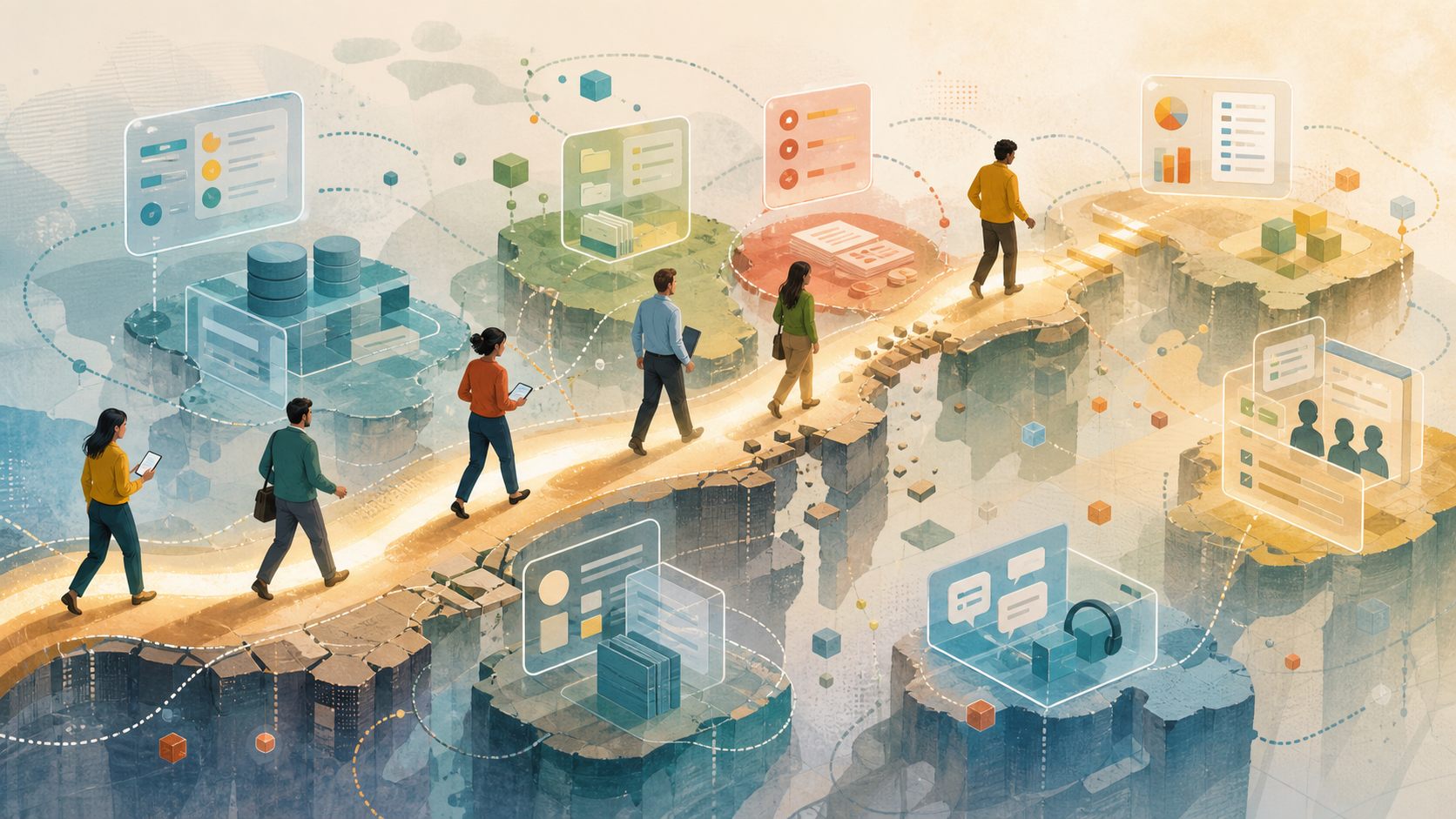
When those moments are scattered across disconnected systems, the organisation creates friction. And friction is expensive.
AI can reduce the Silo Tax or multiply it
The early phase of workplace AI has focused heavily on productivity. Summarise this meeting, draft this email, rewrite this document, generate this presentation, find this information. These use cases are useful but they are only the beginning.
The deeper opportunity is not just helping employees produce more content. It is helping them move through work with less friction. The danger is that every department now creates its own AI layer on top of its own silo.
At first, this may look like progress. In reality, it can become a new version of the same old problem. Instead of navigating a maze of portals, employees navigate a maze of chatbots. That is not transformation. It is fragmentation with a conversational interface.
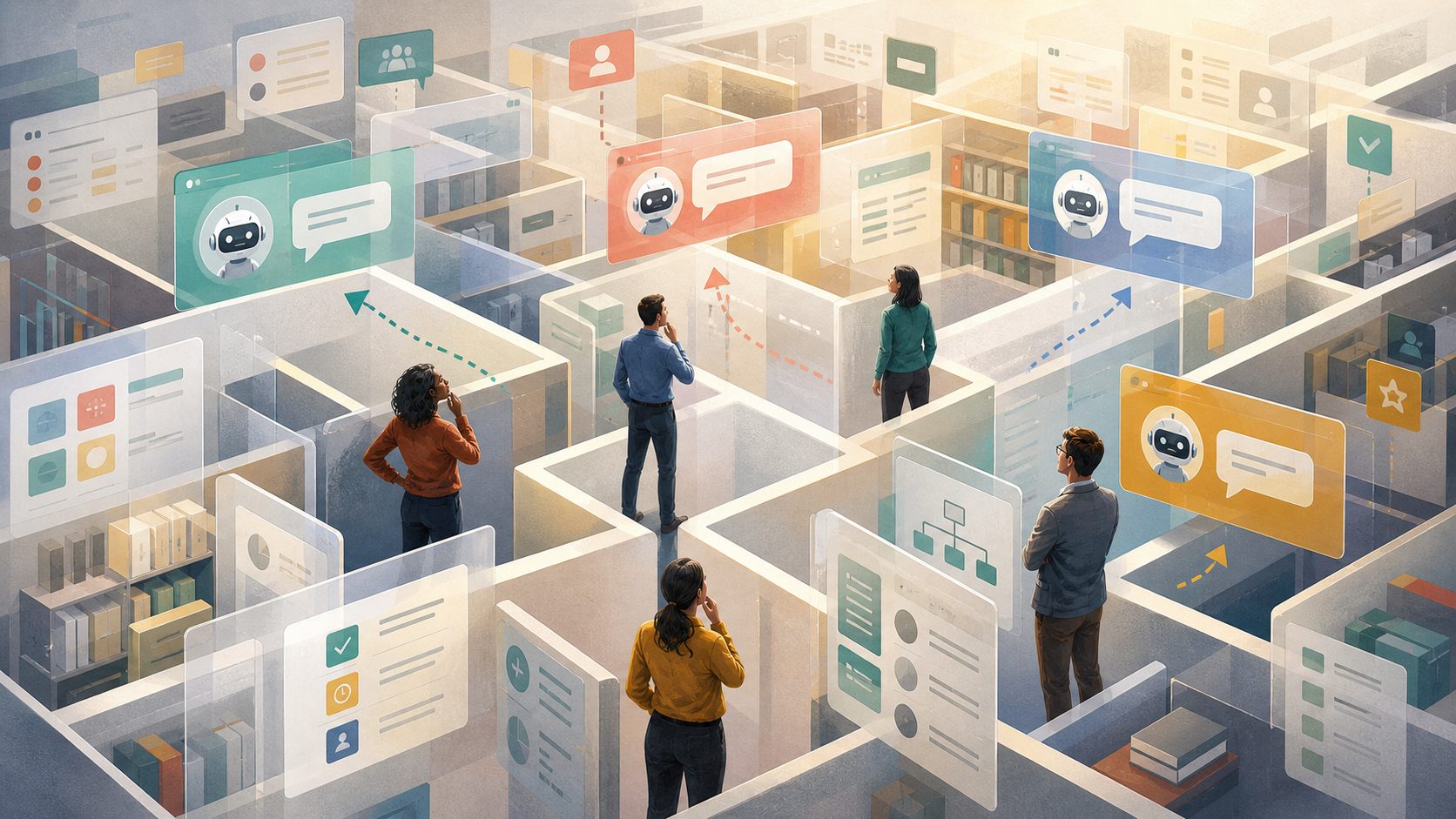
So the real question is not, "Can we add AI to this system?" It is, "Can AI help us redesign the way employees enter, understand and act across the organisation?"
What is a Unified Front Door?
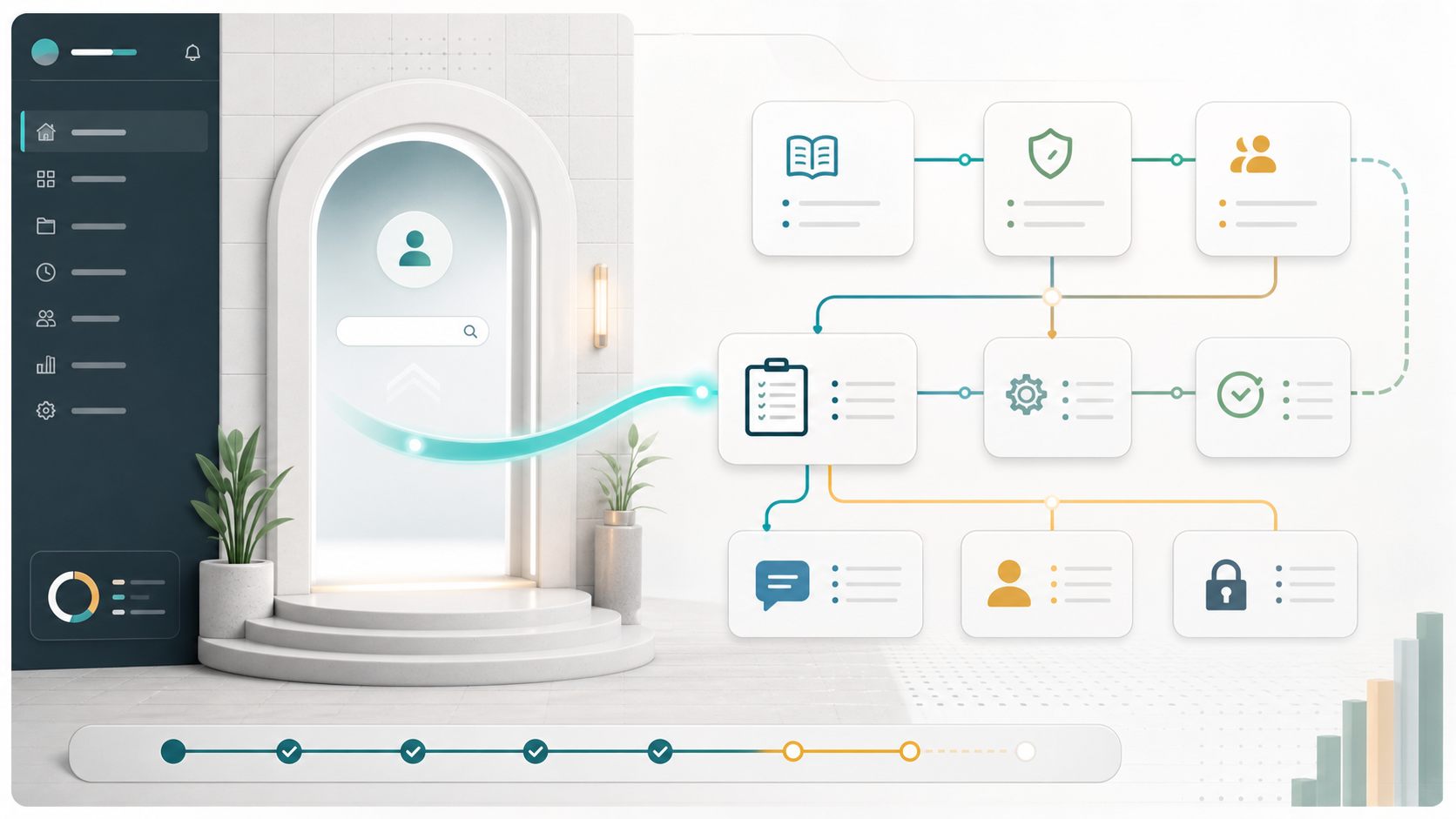
A Unified Front Door is not simply a new homepage, a better intranet or a single agent. It is a governed experience layer that gives employees one trusted place to start.
Behind that front door, the organisation may still have many systems. HR keeps its HR platform. IT keeps its service management tools. Finance keeps its approval workflows. The point is not to replace every enterprise application. The point is to stop making employees understand every enterprise application.
A strong Unified Front Door abstracts the complexity of the enterprise without hiding the accountability behind it.
It connects knowledge, services, workflows and permissions in a way that feels simple to the employee but remains governed for the organisation. For example, an employee should be able to ask, "How do I take parental leave?"
The experience should not stop at a generic answer. The front door should help them understand the policy, check what applies to their situation, identify the right form, start the request, route it to the correct approval path and provide status updates.
That is the shift from search to action. And that is where AI becomes genuinely valuable.
The market is moving from assistants to orchestration
The important signal in enterprise AI is not that any one vendor has the answer. It is that the market is moving in a clear direction; away from isolated assistants that answer questions and toward governed AI experiences that understand context, connect systems and help people complete work.
You can see this pattern across the ecosystem. Service management platforms are embedding AI into workflows. CRM platforms are packaging agents around customer operations. HR and finance platforms are introducing domain-specific agents. Productivity suites are grounding assistants in enterprise knowledge and permissions. Cloud platforms are offering agent builders, retrieval, orchestration, observability and identity controls.
Different vendors use different language, but the direction is similar. AI is becoming less of a chat window and more of a work orchestration layer.
That matters because the opportunity is not to add another assistant to every department. The opportunity is to design a coherent way for employees to move from intent to outcome.
I will be exploring this same tension at Staffbase EXchange Sydney on 11 June 2026, in a breakout session on intelligent collaboration with unified systems. The session is framed around the "Silo Tax" versus the Unified Front Door: the lost productivity, licensing waste and context-switching fatigue that show up when information is trapped in disconnected tools.
Governance makes the front door trustworthy
A smarter AI layer does not automatically create a better employee experience. Messy knowledge gets surfaced faster. Outdated policies become easier to find. Broken workflows become easier to enter. If every department has a different answer to the same question, AI will not magically create alignment. It will expose the contradiction at scale.
That is why the Unified Front Door must be designed with governance from the beginning. Content ownership, source ranking, permissions, auditability, escalation paths, human-in-the-loop approvals, lifecycle management and clear boundaries around what agents can and cannot do.
Without governance, the Unified Front Door becomes another shiny interface. With governance, it becomes a trusted operating layer.
The leadership challenge
The Silo Tax will not disappear because an organisation buys another platform, launches another assistant or runs another AI pilot. It disappears when leaders stop funding isolated experiences and start designing connected ones.
IT, HR, internal communications, operations, legal, security and business units need a shared view of the employee journey. Not just their part of it. The whole journey. From the employee's perspective, departmental boundaries are artificial. They care whether they can get the right answer and complete the task without unnecessary friction.
The question is not simply, "Which AI tools should we deploy?" The question is, "What kind of organisation do we want AI to reveal?"
If AI reveals clarity, ownership, trust and well-designed workflows, it becomes a multiplier. If AI reveals confusion, duplication, outdated knowledge and fragmented accountability, it becomes a mirror.
The future of enterprise AI will not be won by the organisation with the most chatbots. It will be won by the organisation that makes work easier to navigate.
The goal is not to make employees better at navigating complexity. The goal is to remove the unnecessary complexity in the first place. Because the best digital workplace is not the one with the most tools. It is the one where people know exactly where to start.