

Most teams don't start with orchestration.
They start with a prompt. Then they chain another prompt. Then a "please keep it short." Then a second agent to "review it." And suddenly you have a system that looks intelligent but behaves like a group project where nobody knows who owns the final document.
That's the point where orchestration shows up, not as an advanced feature but as a survival skill.
Orchestration exists because LLMs are brilliant within a step but unreliable as the shape of a system. They don't naturally stop. They don't naturally respect boundaries. They don't naturally know what should happen next. If you don't design the flow, the flow happens to you.
This series is about taking that control back. Not with more prompting. With explicit coordination patterns that make multi-agent systems predictable enough to ship.
The real problem orchestration solves
The moment you add a second responsibility, your AI system becomes a coordination problem. Not a prompt problem.
You now have to decide how context moves, who speaks next, whether work can happen in parallel, what "done" means and how disagreements get resolved. If those decisions are implicit, your system becomes "demo-stable" and "production-fragile."
Orchestration is simply you writing down the answers to those questions in a repeatable way.
In Microsoft Agent Framework Workflows, orchestrations are the packaged strategies for that coordination, different ways of connecting agents so they collaborate with less chaos and more intent.
A mental model before the names: flows, not features
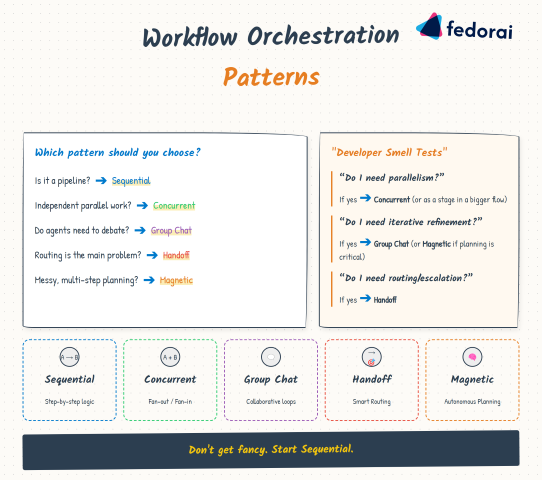
Before we name patterns, I want you to picture the shapes. Orchestration patterns are basically communication topologies with rules.
Some topologies look like pipelines. Some look like fan-out/fan-in. Some look like a moderated meeting. Some look like a routing mesh. Some look like a manager-led team that plans, executes and verifies.
If you can see the shape, you can choose the pattern. So let's bring the shapes in early.
Shape 1: The Pipeline (Sequential mindset)
A pipeline is what you build when the work must happen in order and each step benefits from the full context so far. It's the first pattern most engineers should reach for because it matches how we already reason about systems: step A → step B → step C.
This shape is why Sequential orchestration is such a natural starting point in the workflow docs: it lets you move through agents in order while carrying the conversation forward.
Shape 2: Fan-out / Fan-in (Concurrent mindset)
Sometimes order is not the point. Speed and coverage are.
If you want three independent perspectives such as Support, Policy and Product then you don't need a pipeline. You need parallelism and then a merge. That's a fan-out/fan-in system and it's the shape behind Concurrent orchestration.
Without this shape, most teams fake concurrency by running sequential calls and pretending it's parallel. The cost is latency and the bigger cost is you never design a real aggregation strategy.
Shape 3: The Moderated Meeting (Group Chat mindset)
Some problems aren't solved by "three answers merged." They're solved by iteration—critique, refinement, negotiation and convergence.
That's not a pipeline and it's not fan-out. That's a meeting and meetings need moderation. Group Chat orchestration maps to a star topology where a manager controls the turn-taking and keeps the conversation from becoming noise.
This is where many "multi-agent demos" collapse in production because people forget the two boring questions that make meetings useful: Who decides who speaks next and who decides when we're done?
Shape 4: The Routing Mesh (Handoff mindset)
Now we get into the pattern that looks most like a real business process: routing and escalation.
When the core problem is "who should handle this", you don't want a central moderator forever. You want the system to hand off control to the right specialist and sometimes to a human. Handoff orchestration is described as a mesh-style collaboration and the docs call out the important distinction: this is not "one agent calling other agents as tools". It's conversational control moving between agents.
This is the shape you want when "ownership" is the design problem.
Shape 5: The Planning-led Team (Magentic mindset)
Some tasks don't fail because the agents aren't smart. They fail because nobody planned.
Magentic orchestration is a manager-led approach inspired by Magentic-One, designed for complex open-ended tasks where planning and coordination matter.
This shape is powerful but it's also where you earn the "Dangerous" part of the series title because planning systems can drift if you don't add guardrails and clear termination.
Why this series starts with shapes, not APIs
Microsoft Learn can teach you how to instantiate these orchestrations. That's necessary but not sufficient. Because what makes a workflow system good isn't that it compiles. It's that it behaves in a way you can explain to another engineer.
So we're going to treat orchestration patterns like design patterns. Each post will connect a pattern to a mini-story and a shape, then we'll implement it in .NET (most of the time) using Microsoft Foundry as the backend.
There will be demos which means that means you'll experience what matters: define the system's responsibilities, the shape of the orchestration and the stop conditions. This keeps the series focused on engineering judgment, not just code volume.
Next: the "need" becomes a concrete boundary
In the next post, we'll draw a clean line between "agents" and "workflows" using a simple rule: agents can reason inside a step, workflows decide the system's shape. Then we'll implement Sequential orchestration as the first "non-chaotic" multi-step system.
After that, we climb from Zero → Dangerous one pattern at a time.
Until next time.